Keeping rural stories alive through songs
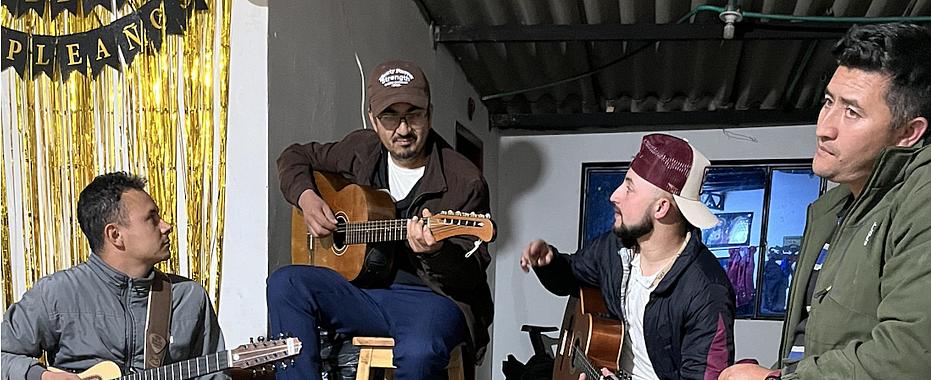
Another restitution of the PREFER work in San Miguel de Sema, Colombia, is taking a musical form.
During the research, a lot of stories were collected about rural life in the municipality: about work, walking, animals, celebrations, crafts, music and the people who made up everyday life. Many of these stories came from older residents, describing forms of rural life that have changed considerably and, in some cases, are close to disappearing. The question was what could be done with this material, beyond keeping it in the research archive.
The idea that emerged with local musicians was to make new songs from these stories. Not songs reproducing old songs, and not simply a recording of what people told us, but original songs built from the words, experiences and stories collected during the research.
Three local music groups (Labranza, Ritmo Campesino and Nuevo Amanecer) agreed to take part.
In the first workshop, in March 2026, each group chose themes that they felt were important to carry forward. Six themes emerged: stories of the paths and walkers of San Isidro; local verses, music and festivities; artisanal crafts; the story of el Puntillas; oxen and yokes (bueyes y yuntas); and the stories of the hateras, the women who worked in milking, which connects this musical work with the documentary being made with the women.
The musicians also decided that, as far as possible, the songs should use the acoustic instruments associated with the local músicas campesinas: guitar, tiple, requinto and guacharaca.
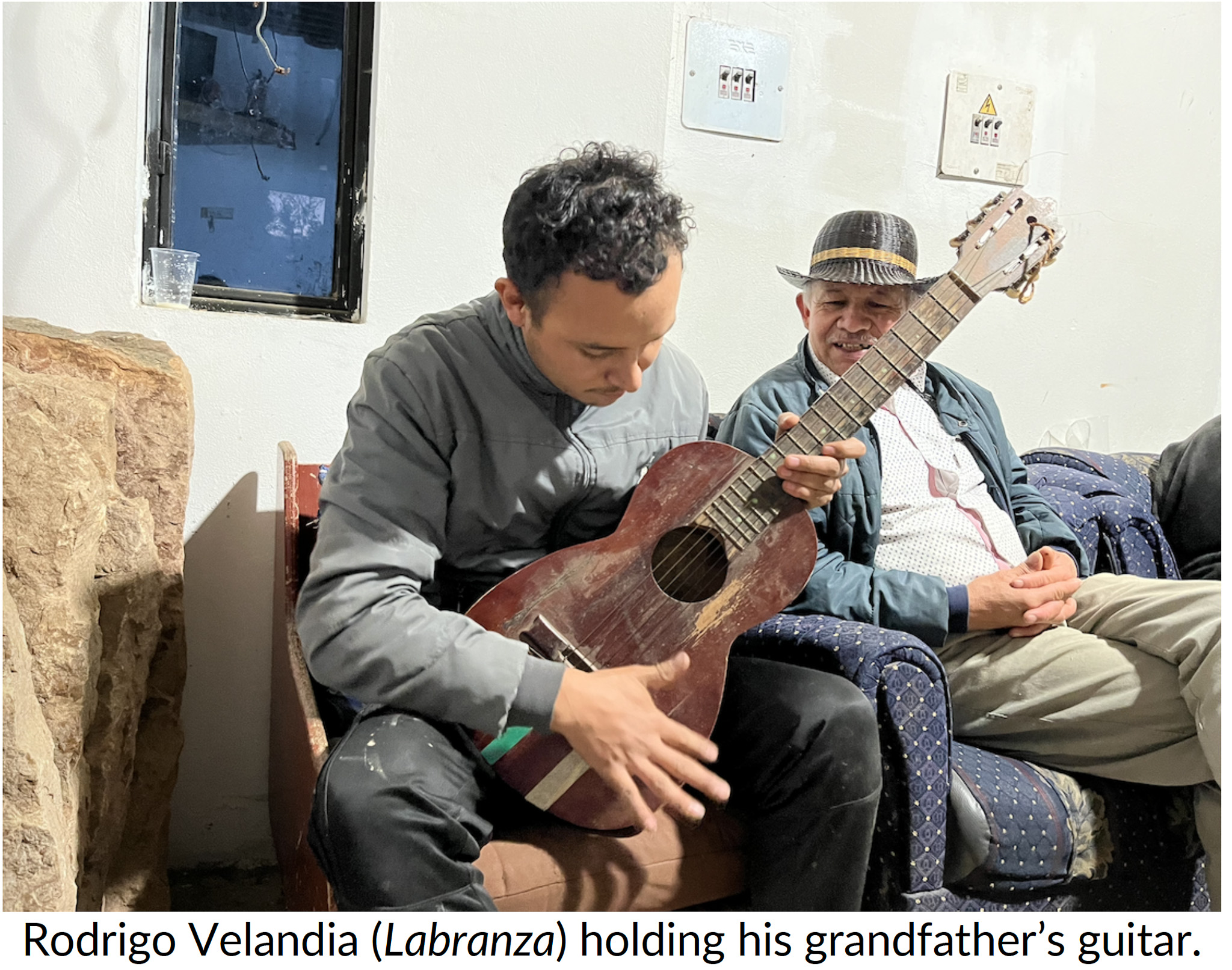
Since then, the work has been a mixture of research and composition. Interviews have been transcribed and organised specifically for the musicians, with attention to particular words, expressions and descriptions that might carry something of these experiences into the songs. The musicians have discussed the material and started working on compositions. One of them, Rodrigo Velandia from Labranza, brought his grandfather’s guitar to the project.
The process is being developed with the Music Department at Pontificia Universidad Javeriana. Professor Estefanía Toro Duque, coordinator of the sound engineering area, is helping with the recording process and with the practical side of producing the final recordings.
There are still several stages to go. Two more workshops with the musicians are planned, followed by the recording of the songs. A small booklet will accompany the recordings, bringing together the songs and some of the stories from which they emerged. The final work is expected to be launched in 2027.
The aim is not simply to preserve a catalogue of old rural practices. It is about cultural continuity: keeping alive connections between what people have lived, what is changing and what can still be carried forward. Some of the experiences described in the interviews belong to a rural world that is changing quickly. Giving them a new form through music is one way of allowing those experiences to continue to circulate, to be heard by people who did not live them.